
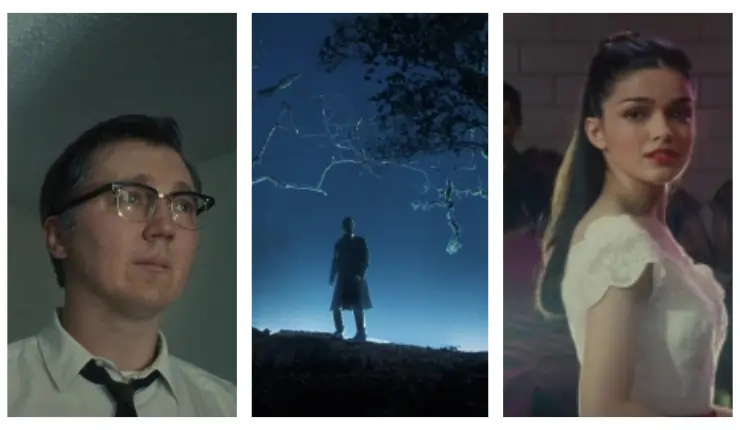
Whether you like him or not, the name Steven Spielberg is quite possibly the most well-known household name for a director there ever was. He is known far and wide, beyond cinephiles and the common movie watcher. You don’t initiate the existence of the summer blockbuster and end up as someone forgettable, but rather as someone who, for better or worse, has changed the landscape of cinema for over six decades. Over that time, he has directed 35 feature films, with his latest, Disclosure Day, currently playing in cinemas across the world, marking the American director’s long-awaited return to the sci-fi genre.
That being said, here is my list of Spielberg’s 10 very best films:
Number 10 – Indiana Jones and The Last Crusade
After the disasters of James Mangold’s Indiana Jones and The Dial of Destiny, the only film in the franchise not to be directed by Steven Spielberg, it’s obvious that few filmmakers are better equipped to produce these films than him. The Last Crusade picks up on the strengths of the original to a far superior degree than Temple of Doom ever managed. We return to the more intimate character relations, this time between father and son, but on a globe-trotting backdrop that felt lacking in the second instalment. And who doesn’t love the endless boobytraps that the last act has to offer, as the small man tries to find immortality?
Number 9 – Catch Me If You Can
The best of Spielberg’s biopic work lies in his 2002 Leonardo DiCaprio-starring Catch Me If You Can, as the filmmaker takes his globe-trotting skills away from fantasy but pulls them down to reality (sort of). Despite such likeness to the real world, though, this film harkens to perpetually faux ideas, as we follow Frank Abagnale Jr. successfully commit millions of dollars worth of check fraud. This film moves at such a speed, inhabiting a vast world of vague tangibility as characters and extravagant lifestyles exist in endless fancy dress parties, where one is never themselves. Spielberg’s Barry Lyndon, if you will.
Number 8 – The Fabelmans
The most recent Spielberg entry on my list is his 2022 semi-autobiographical film The Fabelmans, which, on release, I found to be quite lame, but thanks to a recent rewatch, I have come around to seeing this film as something a lot richer than it has any right to be. The film follows Sammy, a wannabe filmmaker, as he navigates the troubles of his parents’ divorce as well as his first love. This film offers up more than just the common cinephile hit for films about film; there’s a genuineness to its personal nature that never dips too far into being obsessive, but has just the right amount of charm to keep it afloat. Although, seeing two of my favourite filmmakers, David Lynch and John Ford, materialise simultaneously on screen does make me kick my feet a little bit, especially Lynch’s delivery of “NO, NO, NO, NO, NO. WHERE’S THE GODDAMN HORIZON?”
You can read our review for The Fabelmans here – Read our review
Number 7 – Close Encounters of the Third Kind
Moving from one of his latest to one of his earliest, in seventh place, I have the 1977 science fiction classic Close Encounters of the Third Kind. This film best serves as one of the earlier cases of that Spielberg wonder, which exists in his somewhat existential charm. The John Williams score is a frequently referenced highlight of the film, but it functions better as a genre meta-text of cinematic curiosity, heralded by French New Wave legend François Truffaut playing one of the leading characters in the film, Claude Lacombe; something I hadn’t really picked up on until recently. It is both intimate and conspiratorial to a wonderful extent.
Number 6 – Minority Report
Despite the fact that on the surface Close Encounters of the Third Kind would be seen as the thematic predecessor to Disclosure Day, I think the 2002 Tom Cruise starring Minority Report is the one more suited to that mantle; both films dive into the creation of images and surveillance, making for an interesting through line between the two, as opposed to simply aliens. This film follows a world where people can be arrested for crimes before they’ve committed them. It functions as a pitiless wave of death swamped by predetermined fate, as Cruise attempts to navigate a time where he spends most of it looking forward, instead of the current moment – “I’m tired of the future.” It often feels underrated amongst his 21st-century work, but it is one that is frequently compelling and also timely.
Number 5 – Jaws
51 years on, the film that propelled Spielberg into the catalogue of rising filmmakers at the time, Jaws, still holds up to its status as a summer blockbuster-initiator, with the filmmaker showcasing his formal strengths to the entire world; that dolly shot still hits the mark every time. It’s a shame that today’s summer blockbusters pale in comparison to what this film holds culturally and what talent is displayed in its compositions, which is all but non-existent today. Perhaps more than other Spielberg films, this one is really helped by the incredible talent up front; in this case, it’s the incomparable Roy Scheider, whose run in the 1970s is about as good as anyone has ever been.
Number 4 – Raiders of the Lost Ark
One of his first big globe-trotters, Raiders of the Lost Ark, redefined the cinematic sense of what an adventure film could be, yet, like Jaws, it’s led us to a world where expensive films, similar in vein, are being made that lack any of the charm that this film occupies. Harrison Ford’s first outing in one of his many iconic roles sees him melting the face off of Nazis in an endlessly silly product that is home to some of Hollywood’s best set pieces you’re ever likely to see; the way every detail of its sets consumes the frame is magical.
Number 3 – War of the Worlds
As the consensus goes, I think this is still one of Spielberg’s most underrated flicks. War of the Worlds is the most direct of his post-9/11 works, as we bear witness to humanity’s destruction in his 2005 rendition of the classic H. G. Wells novel. It harkens to a set of ideals that are entirely its own thing, making it an adaptation that is able to stand on its own two feet when paired with its originator, which was written some 107 years prior to this film’s existence. Spielberg’s visualisation of paranoia, coupled with a riveting Tom Cruise performance, leaves us with something distilled with pure dread, something departed from expectations of his previous works, thus ill-received on debut, so its current cult-classic status is a welcome sight. Not to mention, a child saying they have back problems is a hilarious bit.
Number 2 – Jurassic Park
Like much of Spielberg’s other work, 1993’s Jurassic Park had the unfortunate success of being so good that it spawned a wave of successors attempting to capture the magic of what he achieved here. Whilst directing one more solid sequel in 97, the franchise was rebooted in 2015, with the result being four dismal products that spend their entire time trying to regurgitate the germane horrors of what is captured here. It’s another prime example of his ability to recontextualise the popcorn flick into something that plays with the limits of humanity and the relevant insignificance of power, helmed by the still groundbreaking CGI work that dominates portions of this film’s set pieces. Despite its illusions, this film is still as visceral as ever.
Number 1 – A.I. Artificial Intelligence
Of all his tremendous run of films, none are more fascinating to me than his early 2000s films. And the best of all within that confine was his 2001 magnum opus, A.I. Artificial Intelligence; I don’t think anything he’s ever made comes close to this either. This film spent over a decade in development under the watch of Stanley Kubrick himself, who realised that Spielberg’s sensibilities were better suited to the task before he died in 1999. The result is a film bound by its friction between memory and clarity. The film personifies the simulacrum of looking into the past, as its own image fragments against its own artifice, fading away to one of the greatest third acts in cinema history as imperfect acceptance takes over.
Art manifests itself in a way compelled by the individual intimacy of its characters, rather than something entirely dedicated to the bigger questions; a deeply disturbed fairy tale that wants to recreate the uncanny nitpicks of a faux past. Spielberg has never, and maybe will never, make anything like this ever again, and that’s why it functions so distinctively, because of how far removed it is from his mega-hit popcorn flicks that had unfortunate cultural impacts following them. His masterpiece – “It is today.”
Discover more from
Subscribe to get the latest posts sent to your email.
