
THE MND ECONOMY INDEX™
Providing broad insight into the Mexican economy
MND Intelligence · Second edition
Welcome to the second edition of the MND Economy Index™, part of the MND Intelligence™ suite of data products from Mexico News Daily.
The MND Economy Index™ is a 10-pillar, 19-indicator composite index that compiles a broad range of economic data into a single score between 0 and 100, giving Mexico News Daily readers a clear, accessible picture of how the Mexican economy is performing across multiple dimensions.
The inaugural edition of the index — using data mostly from the month of March — was published in late May.
In the inaugural MND Economy Index™ article, we not only analyzed the index score — 63.39 out of 100 — but also explained what the index is, why we developed it and how it works. Click here to read (or re-read) those explanations.
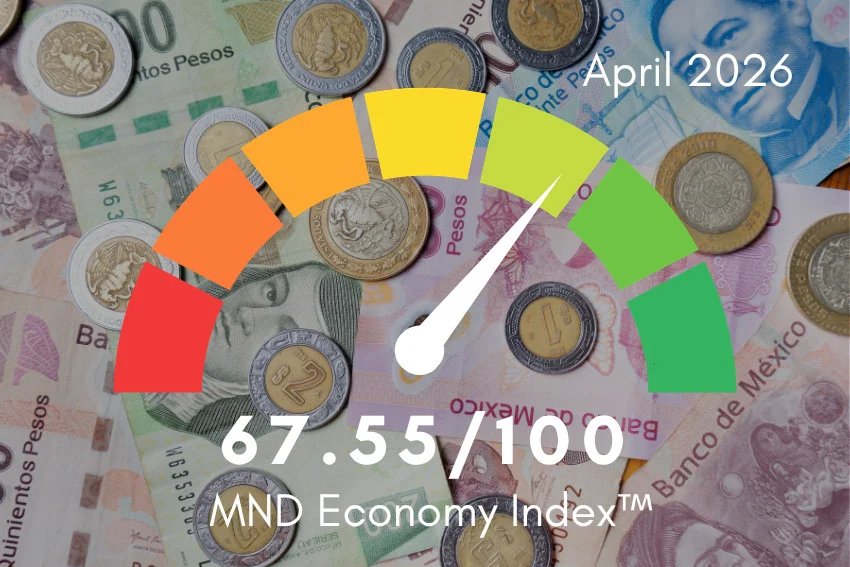
In the June edition of the MND Economy Index™ — which uses economic data primarily from the month of April — the index score increased by more than four points compared to the inaugural edition to reach 67.55. That score is above the neutral benchmark of 60, but there is certainly room for improvement.
Before we look more closely at the latest index result, and the index trend in early 2026, here is a short guide to what the overall index score means.
- 85–100: Exceptional — the economy performing at a high level across nearly all indicators.
- 75–84: Strong — broad-based performance with only minor areas of concern.
- 60–74: Above neutral — meaningful strengths, but with notable room for improvement.
- 50–59: Mixed — passing marks overall, more indicators above benchmark than below.
- Below 50: Broad underperformance — more indicators below benchmark than above.
The MND Economy Index™ trend in early 2026
The first two MND Economy Index™ scores we calculated for 2026 — both corresponding to the first quarter of the year — were very similar.

The first index score we calculated for 2026 was 63.69, a number derived mainly from economic data for the month of February. The index score declined slightly to 63.69 based on a calculation using data that was primarily for the month of March.
While there was little variation in the index score across those two editions, there were some significant changes in individual pillar scores, including the Inflation one and the Sovereign Risk one (see more details here).
Our June edition score, as noted above, is derived mainly from economic data corresponding to the month of April.
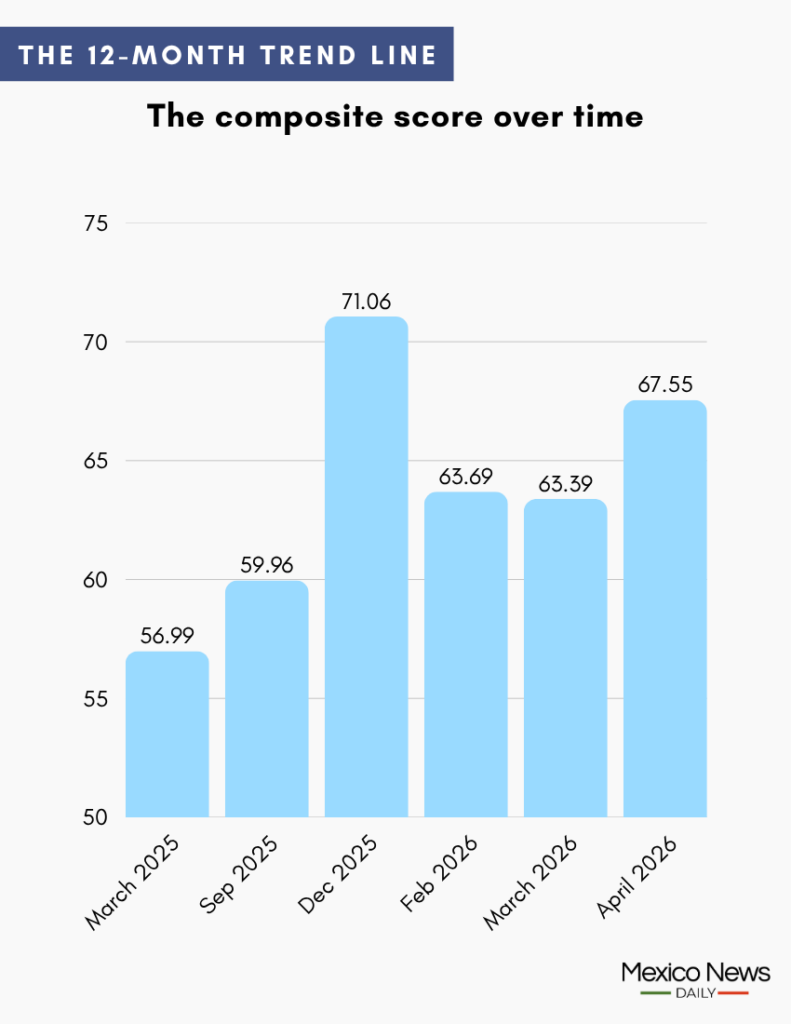
The 4.16-point jump to an index score of 67.55 is an encouraging development. As you’ll see below, the biggest contributor to the increase was the Economic Growth pillar, whose score increased 3.4 points compared to the inaugural edition of the MND Economy Index™.
The June edition of the MND Economy Index™ (based mainly on April data)
As noted above, the MND Economy Index™ score for this June edition — based mainly on data for April 2026 — was 67.55, a 4.16 percentage point increase compared to the previous month. Below you will see the score for each of the ten pillars that make up the index, expressed out of 10 to reflect each pillar’s exact contribution to the final composite score.
Pillars are color-coded using a traffic light system: green (a score above 7.5) indicates strong performance; yellow (5.0–7.5) signals decent performance but with room for improvement; and red (below 5.0) flags a pillar that is falling short of its benchmark. Where a pillar score has improved compared to the previous month, an upward arrow appears alongside its corresponding traffic light; a downward arrow indicates deterioration; and a pause symbol denotes no change.
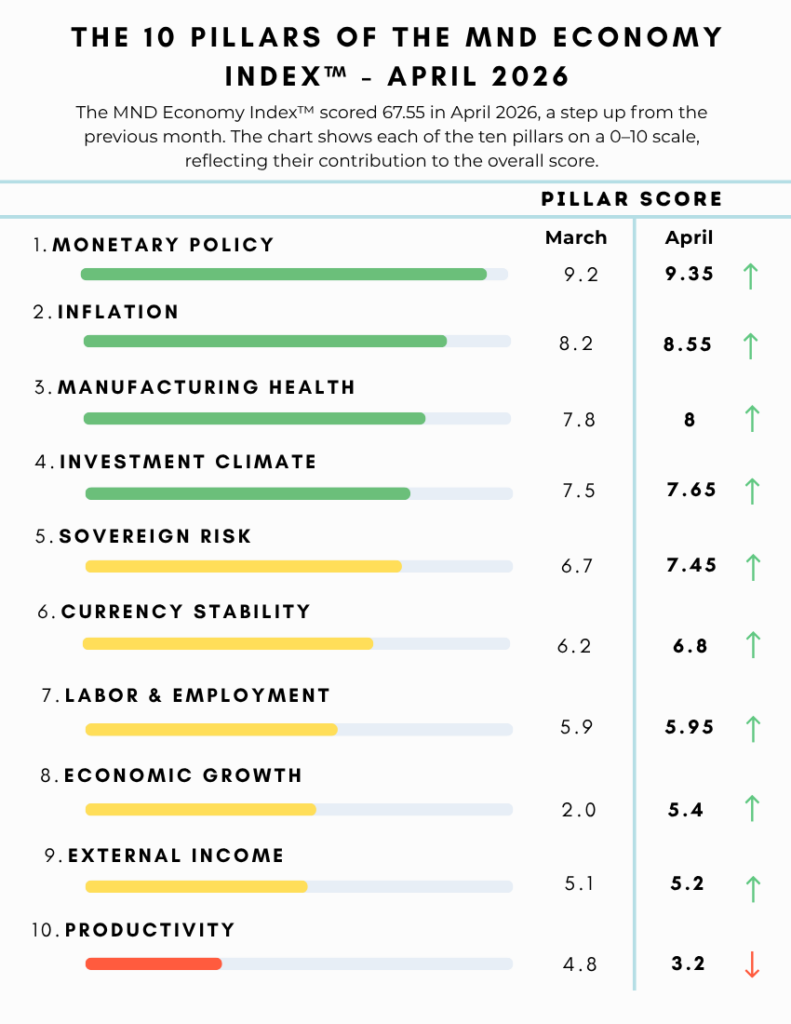
As you’ll see below, scores for nine of the ten MND Economy Index™ pillars increased in April compared to the previous month.
🟢 ⬆️ MONETARY POLICY (9.35):
The score for this pillar improved to 9.35 in April from 9.2 in March. The Bank of Mexico’s benchmark interest rate remained at 6.75% in April after a 25-basis-point cut to that level in late March. The rate is just above the top end of the central bank’s estimated neutral range. The improvement in the pillar score came solely from the change in Mexico’s real interest rate — i.e., the Bank of Mexico’s benchmark interest rate minus the annual headline inflation rate. The real interest rate in April was 2.30%, slightly closer to the 2.7% neutral midpoint than the 2.16% real rate in March. The improvement in the overall score for this pillar ensured that Monetary Policy remained the index’s top-performing pillar in April 2026.
🟢 ⬆️ INFLATION (8.55):
The score for this pillar increased to 8.55 in April from 8.2 in March. Inflation eased to 4.45% in April from 4.59% in March, causing an increase in the score for the current inflation component of the pillar. The score for the pillar component that considers the 12-month forward inflation forecast also improved, as the Bank of Mexico anticipates an annual rate on par with its 3.0% target in April 2027. The central bank forecasts that the annual inflation rate will be slightly above its target in the first quarter of next year.
🟢 ⬆️ MANUFACTURING SECTOR HEALTH (8):
The score for this pillar also increased in April, rising to 8 from 7.8 in March. The exports component of the pillar remained at the maximum score due to a 32.6% annual increase in export revenue in April, up from a 27.7% year-over-year gain in March. The increase in the overall pillar score was due to a higher annual increase in manufacturing output in April compared to March. Manufacturing production increased 1.9% annually in April, up from 1.1% in March.
🟢 ⬆️ INVESTMENT CLIMATE (7.65):
The score for this pillar increased to 7.65 in April from 7.5 in March. The pillar thus moved into green traffic light territory. The top contributor to the pillar in April was the S&P/BMV FIBRAS Total Return Index, which tracks the performance of Mexico’s listed real estate investment trusts. The index grew 32.2% annually to the end of April, up from a 27.9% year-over-year increase at the end of March. The score for the foreign direct investment component of the pillar fell slightly as data published by the Economy Ministry in May showed that FDI increased 10.4% annually in the first quarter of 2026, a result that is marginally weaker than the 10.8% growth recorded in 2025. The 10.8% annual growth rate for FDI was used in our previous edition of the MND Economy Index™ as the Q1 data was not available at the time.
🟡 ⬆️ SOVEREIGN RISK (7.45):
The score for this pillar increased to 7.45 in April from 6.7 in March. Mexico’s sovereign credit ratings from Fitch (BBB-), S&P (BBB) and Moody’s (Baa2) remained unchanged in April, and therefore there was no change in that component of the pillar score. Moody’s downgraded Mexico’s credit score to Baa3 in May. Also in May, S&P revised its outlook on Mexico’s sovereign rating from stable to negative, a development that — in addition to Moody’s downgrade — will weigh on this pillar in the next edition of the MND Economy Index™. The improvement in the overall pillar score in April came entirely from a narrowing in Mexico’s 5-year credit default swap spread, which declined to 89.70 basis points in April from 110.29 basis points in March. The decline reflected a decrease in the market-implied cost of insuring against a Mexican sovereign default.
🟡 ⬆️ CURRENCY STABILITY (6.8):
The score for this pillar increased to 6.8 in April from 6.2 in March. The improvement in the score was due to decreased volatility of the Mexican peso in April. The standard deviation of daily exchange rate movements fell to 0.47% in April from 0.94% the previous month. The increase in the score for that component of the pillar more than offset a decline in the spot rate score. The score for that component declined as the peso strengthened against the US dollar in April to trade at 17.47 to the greenback at the end of the month. The exchange rate thus moved further away from the index’s 19.00 USD:MXN baseline, which is based on the 2025 average rate. This pillar penalizes significant deviation from the 19.00 USD:MXN baseline in either direction, recognizing that a peso that has strengthened too far from this benchmark can erode export competitiveness and reduce the purchasing power of remittances, just as a weakening peso raises import costs
🟡 ⬆️ LABOR AND EMPLOYMENT (5.95):
The score for this pillar increased slightly to 5.95 in April from 5.9 in March. The improvement was due to a 1.5% annual increase in the number of people in formal sector jobs, up from a 1.2% gain in March. Nominal wages rose 6.9% year-on-year in April — down fractionally from 7.1% in March, but still well above the 3.5% benchmark. The overall pillar score was held back by the informality component, as the share of workers in the informal economy grew by 0.5 percentage points year-on-year. Over 55% of all Mexican workers worked in the informal economy in April.
🟡 ⬆️ ECONOMIC GROWTH (5.4)
The score for this pillar surged to 5.4 in April from just 2.0 in March. The sharp increase was due to a significant increase in Mexico’s annual economic growth rate. The annual growth rate in April was 2.2%, according to final data published by INEGI this week. The annual economic growth rate in March was just 0.5%. With GDP growth exceeding 2% in April, the score for this pillar exceeded 5 for the first time this year. While Economic Growth remains one of the index’s worst-performing pillars, the significant increase in the score is a clear positive. President Claudia Sheinbaum predicts that economic activity will pick up in the second half of 2026 as new public and private investment projects commence. World Cup-related spending, including by international tourists, could also increase Mexico’s growth rate in June, and also possibly in July.
🟡 ⬆️ EXTERNAL INCOME (5.2)
The score for this pillar also increased slightly in April, rising to 5.2 from 5.1 a month earlier. Incoming remittances grew 3.7% year-on-year — a decline compared to the 4.9% increase in March. Still, the remittances component of the pillar again provided a solid contribution to the pillar score, even as annual growth of the monetary transfers slowed. Ironically, the slight improvement in the overall pillar score was due to a 2.3% annual decline in tourism revenue. While the decline in tourism revenue was bad news, the contraction was not as large as the 4.4% year-over-year decrease in tourism spending in April.
🔴 ⬇️ PRODUCTIVITY (3.2):
The score for this pillar plummeted to 3.2 in April from an already low 4.8 in March. Data published by the national statistics agency INEGI in June showed that the IGPLE — INEGI’s quarterly productivity measure — increased only 0.1% annually in the first quarter of 2026. That level of productivity growth was significantly weaker than the 0.9% reading in the final quarter of 2025. An annual productivity growth rate of 0.1% is well below the 1.0% neutral benchmark, and thus, the score for this pillar is very low. In this edition of the MND Economy Index™, Productivity replaces Economic Growth as the worst-performing pillar.
Mexico News Daily
