
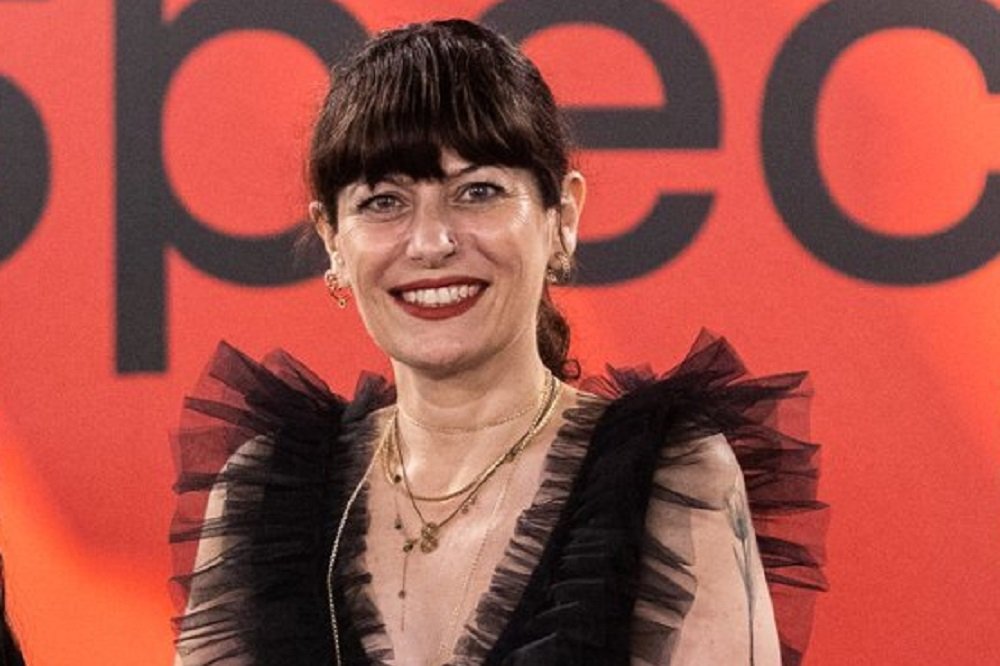
“I needed the audience to feel a breath while also sinking them into the darkness of each character”
– The Cypriot filmmaker discusses her warm-hearted sophomore feature, which explores maternal figures, found family and sacrifice for those you grow to love
(© Film Servis Festival Karlovy Vary)
Cypriot director Tonia Mishiali talks about The Lion at My Back, now vying for the Crystal Globe at Karlovy Vary, her second feature after Pause, which also premiered at the festival but in the now-defunct East of the West strand.
Cineuropa: The film’s context of migration is not necessarily about assimilation or escape, but about discovering one’s place – for both Mariama and Stella. How were you thinking about this topic?
Tonia Mishiali: It was a very challenging theme to handle, because there were a lot of films about migration when I started writing this in around 2017 or 2019. Back then, it was a bit of a hot subject, but then people started going, “I don’t want to watch a film about migration.” Migration is an issue that exists, so why don’t you want to watch a film about it? I never intended to do a film just about migration, as you said. It’s also about motherhood and their relationship. It just happens that one is an immigrant, the other is an ex-drug addict and their paths meet.
One of my favourite moments is when Mariama and Stella of them share what they like about the other. It’s so vulnerable, and it says a lot about each of their personalities.
It’s one of the scenes that I’m very proud of. That scene was actually in the script from the first draft, and I think I shot draft number 20 or something. I don’t remember how it came to me, because I went through a lot of things with the script. I think it was a playful way to show Mariama’s character at the beginning while trying to bond with Stella, who was kind of dismissive. When Mariama asks Stella something, she didn’t want to answer – she’s pretending. It’s like the veil was lifted in that scene.
What about the casting? Even when they two of them are butting heads in the beginning, the chemistry is palpable.
I knew Elena, who plays Stella, from theatre and other films that she played in. I knew she was a great actress, so I wanted to meet her and see if we matched, because I’m very instinctual. We went for coffee and drinks to see if we matched, in terms of respect and energy. It was clear that she was the one. For Mariama, I had originally cast a non-actress from Somalia months before the shoot, and we started rehearsing. But she disappeared one and a half months before the shoot. That’s why I dedicated the film to her in the end, where it says [in the titles], “wherever you are”, because I don’t know where she is. She’s been moving around to different countries since last year because she had to flee Cyprus. It was a life-threatening situation. I remembered why I wanted to make the film own the first place.
I was worried about her and I found out she was okay after a week. She called me. We kept in touch a little bit, as far as she could, and then I had to recast. I got some help from casting directors in Greece, France, Italy. I found Sokhna, who was 20 when I cast her, when she didn’t have much experience, but she did work on some films [after I cast her]. It was a risk to see if she would match with Stella, but she did, and I’m very happy about that.
On a different type of discovery, could you share a bit about the discovery of locations? You have a variety of different settings that build a unique picture of the world only the two of them really understand.
Some locations were written in the script. From the beginning, I knew I was going to shoot in Larnaca, as I imagined it there. Even though I’m from Nicosia, and it would be more expensive to shoot in Larnaca, we managed to do it. The spaces, for me, were important, because I needed the audience to feel a breath while also sinking them into the darkness of each character. I do stay close to the characters [with the camera], and it’s quite intense. Cyprus is known as this country where it’s beautiful beaches, and touristic, and exotic and all that, so I like the contrast of putting these characters in these spaces, because that’s our reality.
You have this mid-film scene in which Stella is brought back into the world of underground sex parties to earn the money she needs. It’s so different, tonally and stylistically, to the rest of the film. Could you talk about the aesthetics of this scene?
I wanted this scene to stand out – it was deliberate, for sure. I like this shocking factor in a way, because it’s realistic at the beginning, and then you enter this specific world. I do have this tendency to include the more surreal in my films. Visually, we talked a lot about it with my cinematographer on how to approach it. The [lighting] colour was something that he suggested, and we worked from there. He suggested that we do the club scene in magenta, and then we thought to connect the two. For Stella, it’s a surreal moment in her life, because she just got out of this world. I knew it was a risk, but if the audience follows this character, they would follow her naturally.
