
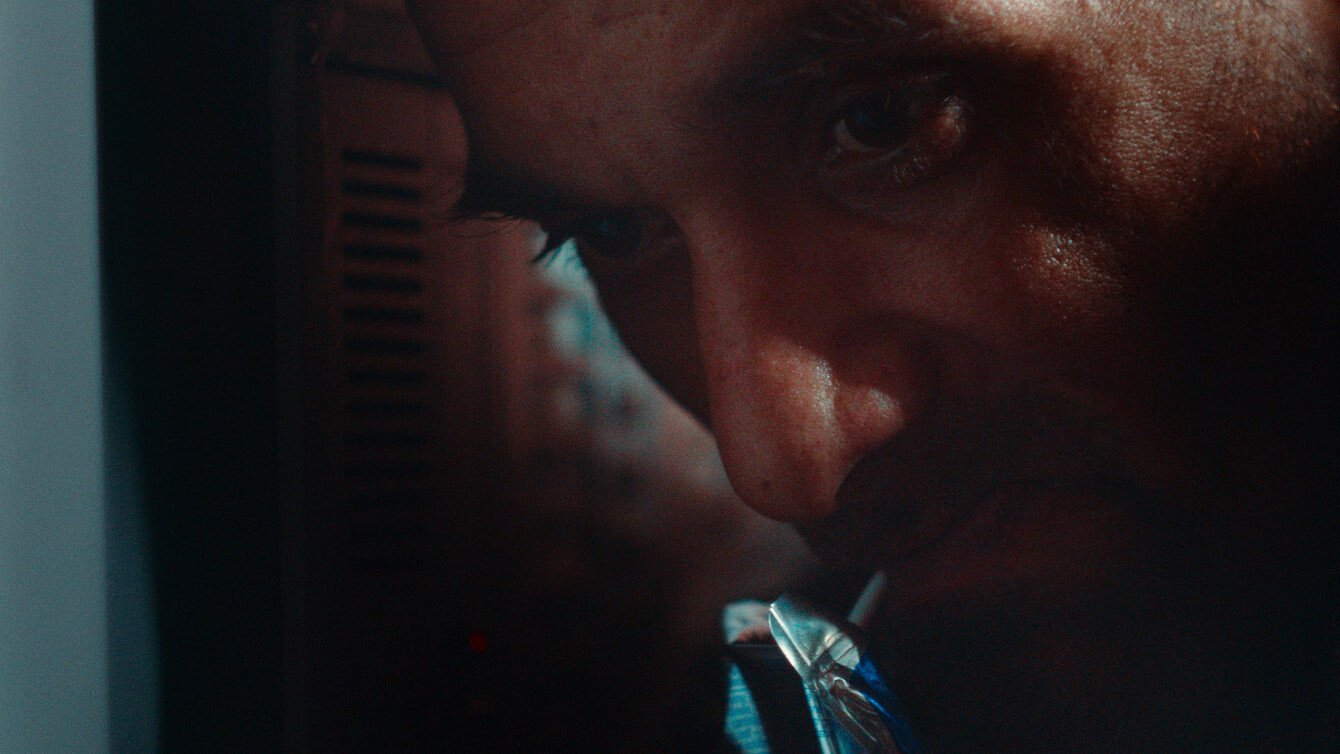
– Slovak filmmakers Anna and Šimon Domček’s first feature is a docufiction hybrid about a Roma man suffering from trauma after a brutal attack that almost killed him
Milan Daniel in 33 Steps
Slovak cinema has had what could almost be termed a trend of docufiction hybrids dealing with the Roma community, from Iveta Grófová’s Made in Ash to Pavol Pekarčík’s Silent Days. Both of these premiered at the Karlovy Vary International Film Festival, and now two debutants, Anna and Šimon Domček, have brought their contribution, 33 Steps, to the gathering’s Proxima section.
33 Steps is a fiction film in which non-professional actors play themselves in a story based on their experiences – or rather, that of Roma man Milan Daniel, from the area around the Czech-Slovak border, who was brutally beaten up but survived thanks to what he believes was God’s providence. In a deep, raw voice-over, he tells us how he saw both the devil and God while he was in a coma, and that the latter warned him not to seek revenge.
He now works as a security guard and a sort of janitor at an unidentified company, and has a wife, Jana, and two pre-adolescent sons, Mili and Gabriel. When he hears that one of his assailants, Erik – who was actually his roommate and had set up the attack – is about to be released from prison, his trauma resurfaces. He dreams of Erik and transposes this obsession and paranoia onto Mili, without revealing the specific reason to him. The boy ends up taking a knife to school, which prompts the psychologist to invite Milan for a conversation, but he doesn’t seem to take it seriously – probably because he is so preoccupied with not knowing what to do about Erik. We see him repeatedly buzzing the man’s intercom, as he is unable to find out when he will be released.
The film was shot on what looks like Super 8 or 16mm, with a very dark image and heavy grain. The press notes mention a 1.77:1 aspect ratio, but it looks much tighter, due to the fact that there are virtually no wide shots. The frame is always crowded, the faces are huge and almost never fit the screen, and the surroundings are often hard to make out. The camera is mostly on Milan, looking frightening with his scarred, shaved head and jutting lower jaw. But obviously, he is the one who is most afraid.
Editing by Daniel Robert Emanuel, who also shot the picture, is fragmentary; it is difficult to work out how much time has passed between the segments, so the audience stays rather removed from the story, which is paradoxical, bearing in mind how physically close to its eyes what is happening on screen actually is. There is a lot of intense sound design and some small, disturbing snippets of electronic music, all of it contributing to a sense of claustrophobia, and easily conjuring up many other phobias, the film being as tonally dark as it is visually.
However, altogether the film is too scattered to congeal into a strong viewing experience, and the fact that the protagonist has a presence but is not very expressive makes it difficult for the viewer to connect. That said, the filmmakers are talented and show promise, touching upon many themes that are linked in interesting ways: faith, superstition and paranoia, the masks we wear (including superhero ones), the perception and position of Roma people, parenthood and the ambivalence of guilt.
33 Steps is a co-production between Slovakia’s escadra, Czech Republic’s endorfilm and Instituto di Neorealismo di Modena.
