
– The jury has praised the emotional power of Natxo Leuza’s documentary, produced by En Buen Sitio, which tackles climate change with courage and realism
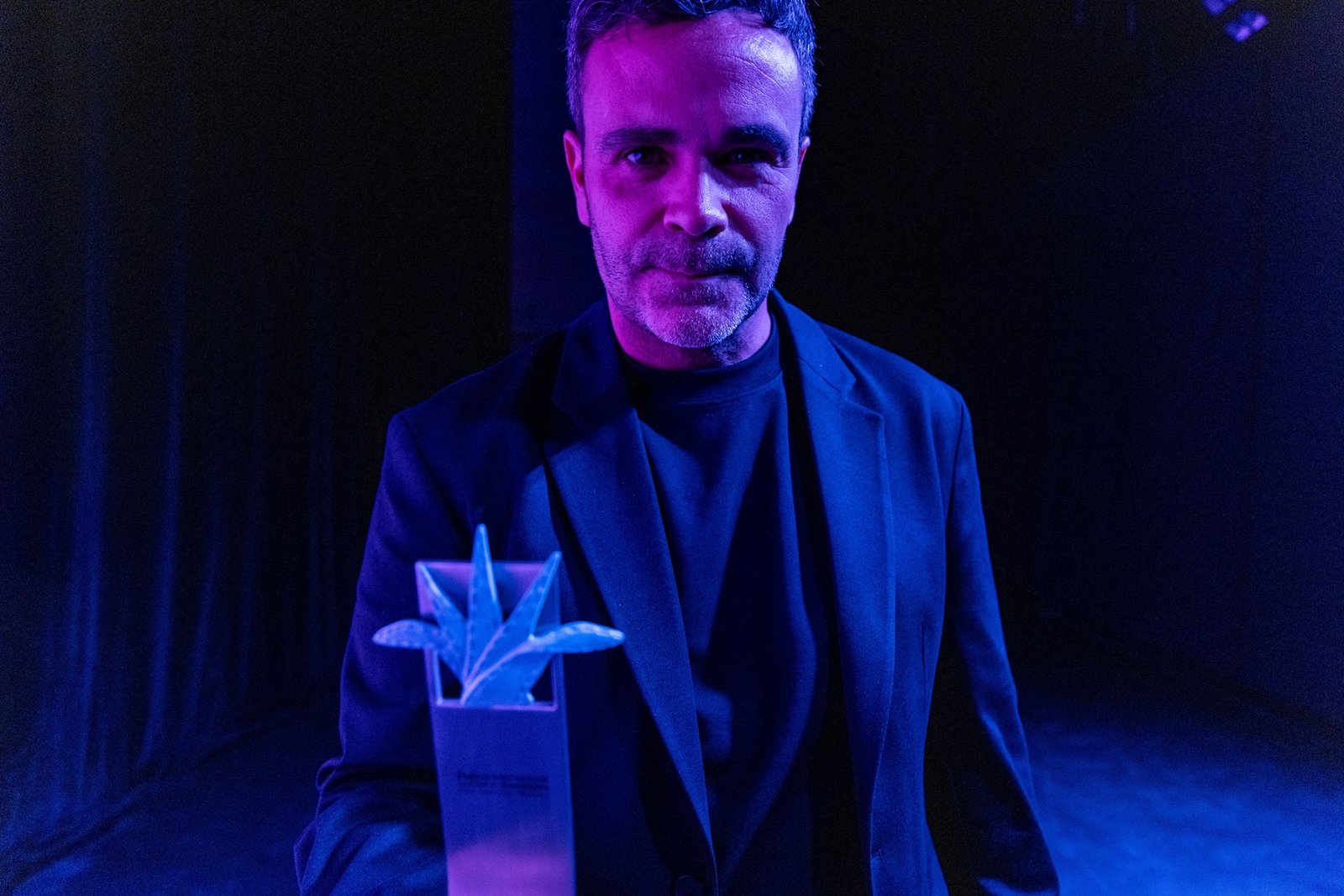
Director Natxo Leuza with his prize (© Guadalajara Film Festival)
Black Water, the non-fiction film directed by Natxo Leuza, and produced by Jokin Pascual and Lucía Benito of Navarre-based company En Buen Sitio, has won the Socio-Environmental Film Prize at the 41st Guadalajara International Film Festival (Mexico), which closed last Saturday, 25 April. The jury recognised the film “for its profound emotional impact in addressing an issue that affects families, communities and entire cities, with a clearly global resonance”.
“The film portrays, with sensitivity and power, the effects of a climate threat that consumes its characters, as well as their constant struggle to withstand and overcome it. Through an intimate and powerful lens, it shows how water – both a source of life and a destructive force – collides with the resilience and perseverance of individuals and communities. Its sensitive and original approach forges a genuine connection with the viewer. Beyond a specific territory, the film transcends borders and confronts us with a universal truth: the empathy we feel for its characters is, in reality, a reflection of what we feel for humanity itself. It reminds us that we are all, in different ways, living through and being affected by these changes. Through the solid execution of all its elements, the film succeeds in clearly bringing to life what socio-environmental cinema should represent: exodus, the breakdown of family units, transgenerational fractures and the fragility of our shared world,” concludes the verdict.
After collecting the award, the filmmaker said: “Receiving the Socio-Environmental Film Award at the Guadalajara International Film Festival is a source of immense joy and pride. Given the festival’s prestige, it provides a vital boost to ensure the film travels, is seen and reaches more people. For me, this award is not just a cinematic accolade, but also a way of raising the profile of the people who appear in the film and of a crisis that often seems distant, yet is already transforming the lives of millions of people. Black Water is about Bangladesh, but in reality it is about the future of us all. I hope this award helps the film reach a wider audience and that, through these stories, more viewers can feel the urgency and the human dimension of the climate crisis.”
The director/screenwriter continued, “Going up to collect the award at the closing ceremony was very special because I felt that, in a way, I wasn’t going up alone. The whole team was with me, as well as Lokkhi, his family, Shakila, Roy and all those people who are already experiencing the consequences of the climate crisis, as seen in the film. For me, the award only makes sense if it serves to amplify their voices. It was also very moving to receive this recognition in Mexico, at such an important festival as Guadalajara. I felt a great sense of gratitude, but also a responsibility to continue supporting the film, defending it and ensuring it reaches as many viewers as possible.
“Both the production company, En Buen Sitio, and the entire film crew would like to dedicate this award to the film’s protagonists. They represent millions of people who, due to various conflicts, are forced to leave everything behind: their homes, their land, their way of life and their connection to the place they belong. We continue to perceive the climate crisis as something distant, slow-moving, almost abstract, when in reality it is already forcing thousands of people to leave their homes every day. If we do not react in time, we risk normalising one of the great crises of the 21st century: a scenario of climate apartheid where those with resources can pay to escape global warming, famine and conflict, whilst the most vulnerable pay the highest price for a crisis they did not cause. This award is for them,” says Leuza.
“And I hope that this award will, above all, help raise awareness of the issues addressed in the film. May it help Black Water reach more festivals, cinemas, media outlets and audiences. The climate crisis is often discussed in terms of figures, reports or forecasts, and the film attempts to put a human face to that reality. I hope this recognition helps more people understand that what is happening in Bangladesh is neither a distant nor an isolated problem. It is a warning of what could happen in many other parts of the world if we fail to act. Bangladesh is on the front line, but the climate crisis affects us all, even if not everyone suffers it with the same intensity or has the same resources to defend themselves. I would also like the award to help spark conversations. For people, after watching the film, to ask themselves what responsibility we have, what kind of world we are building, and who is paying the price for our inaction. If the award helps these questions reach a wider audience, then it will have fulfilled a very important role,” he concludes. Black Water has screened at film festivals including CPH:DOX 2025, Málaga, FIFDH, Watch Docs, the Berlin Human Rights Film Festival and FIPADOC 2026, amongst others, and will be shown at the San Sebastián Human Rights Film Festival on Wednesday, 29 April.
(Translated from Spanish)
